ROME
Abbazia di Fossanova
The Abbey of Fossanova is a perfect representation of what I expected the Italian countryside to be. In a way, the building looked just like many other churches in Rome—monochrome, symmetrical, yet almost insignificant relative to some of the grander structures we’ve seen. Typically, as we’ve observed in various churches, a simple exterior often hides an extravagant interior. I expected the same from this abbey. However, when I entered, I was surprised by the simplicity within. The architecture mirrored an exterior that was clean, minimal, and unadorned. There was a row of pillars on each side, and a glowing, circular window hung high above the altar.
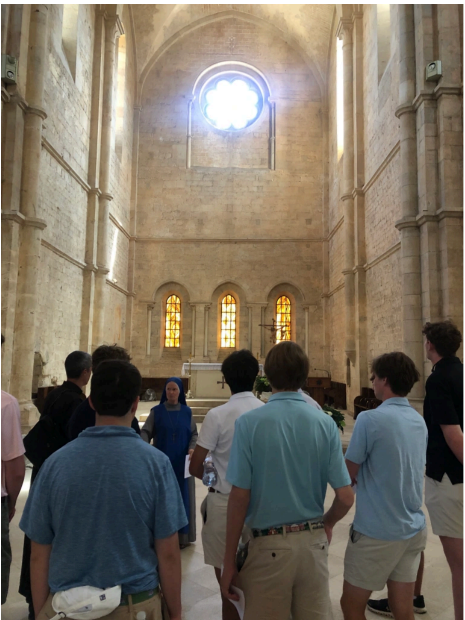
Sister Theotokos was fantastic. “If you’re called nothing else is good enough. 24/7.”
As I walked closer, more subtle details emerged. Despite the overall simplicity, the pillars were depicted with fern-like designs. The sister explained that we were like insects—small and insignificant below the ferns, yet granted space to rise through the tall, hollow arches. She called the abbey a “gymnasium for the spirit,” a place where one’s soul could exercise through prayer and hymns. Like physical exercise, spiritual well-being requires consistent effort. Nothing else can replicate that type of feeling.
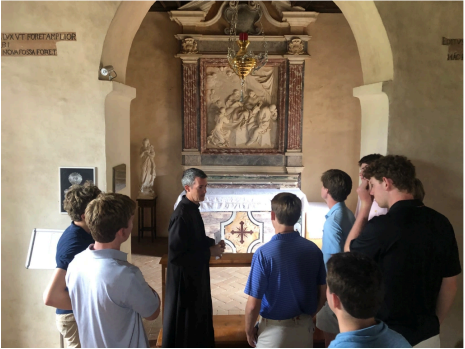
Brother Michael Scott took us to see the location where St. Thomas Aquinas
passed from this life. Note the stunning Bernini lying above his memorial.
In many ways, monks and sisters are some of the most decadent people of our time—but not in the sense of indulgence. Secluded in rural Italy, they have committed their lives to prayer. Even when their prayers don’t resonate, they continue. They do this for the betterment of those in need.
During our visit to the library, I was surprised to find Chinese-Italian dictionaries and texts analyzing Buddhist thought. That kind of intellectual and spiritual rigor is another form of decadence. In this context, decadence isn’t negative—it’s a deep preservation of tradition, something we increasingly lack today
At the same time, these monks and sisters are pioneers. Toward the end of our visit, we came across a row of small pillars dividing the central garden from the walkway. Each was carved with a unique pattern. The sister explained that they were created to honor Pope Innocent III. Despite being part of a strict Cistercian order, these clergy members were willing to incorporate change. This might seem trivial, but it’s often these small acts that sparked innovation.
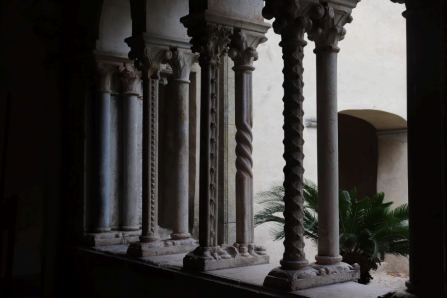
The Cistercian monks got creative for Pope Innocent III’s visit
Decadence, then, is not absolute—it exists on a spectrum. The abbey has two symbolic windows: one with 24 petals, representing the 24 hours in a day; and another with 8, representing the 7 days of the week, with the 8th symbolizing a new beginning. The windows represent the past and the future, respectively. Standing in the center of the abbey, we are not entirely decadent, nor are we fully detached from history.
To prepare for our fishbowl discussion today, we read excerpts from Edward Gibbon and then spoke about the fall of the Roman Empire and how its outdated political structure contributed to its decline. Yet later, we noted parallels between the American Constitution and the Roman Senate-emperor relationship. Clearly, we have changed. Just yesterday, some of us discussed how Mussolini excavated Roman ruins to piggyback on the empire’s former glory. Tonight at check-in we all seemed to agree that religious practices still offer meaningful spiritual grounding.
Decadence isn’t all-or-nothing. What matters is recognizing the difference between a Mussolini and an Abbey of Fossanova
